Purchasing a Home
USING CALCULATOR.NET:
Let's say you are looking to purchase a $225,000 house and you put roughly 10% down. This means you are going
to borrow roughly $200,000. ($225,000 x .10 = $22,500 down payment.) $225,000 - $22,500 = roughly $200,000).
Inside the calculator below enter the following information:
Loan Amount: $200,000 (Mortgage Amount)
Loan Term: 30 years (Mortgage Years)
Interest Rate: Your State's Average Interest Rate from the PopUp window above.
Let's say you are looking to purchase a $225,000 house and you put roughly 10% down. This means you are going
to borrow roughly $200,000. ($225,000 x .10 = $22,500 down payment.) $225,000 - $22,500 = roughly $200,000).
Inside the calculator below enter the following information:
Loan Amount: $200,000 (Mortgage Amount)
Loan Term: 30 years (Mortgage Years)
Interest Rate: Your State's Average Interest Rate from the PopUp window above.
NOTE: This website has its scroll bar located to the far right. Inside this website are
embedded websites that have their own scrollbars.
embedded websites that have their own scrollbars.
Always remember when you purchase a house and start making payments, it is truly a PITI (sounds like pity).
Principal
Interest
Taxes (real estate)
Insurance
Your monthly payment will include Principal and Interest that you owe your financial institution + real estate
Taxes + house Insurance.
Let's look at these terms starting with Principal and Interest:
Principal is the sum of money borrowed that remains unpaid. Let's say you purchase a home for $225,000
and put roughly 10% down. This means you borrowed roughly $200,000 to purchase your starter home. This
is called the principal amount you owe the financial institution. The good thing is every payment you make to
the financial institution (bank, credit union, etc.), you owe that institution less since some of your payment
goes to pay interest and some of your payment goes to pay down the principal. After you make your first
payment, you owe the bank less principal and this continues until the mortgage is paid off. You'll be seeing
how this works using the amortization schedule calculator below.
Interest Rate is the rate of return the financial institution receives for your borrowing of their money. This rate
is usually stated as an annual percentage rate (APR).
Taxes (real estate) is a tax on your property (also known as property tax) and is usually included as a part of
your monthly mortgage payment.
Insurance (homeowners) provides coverage from loss to property. The financial institution that is lending
you the money generally requires you to have insurance on your house to protect itself in case of damage to
the property.
Let's say you have done your due diligence and have been pre-approved for a mortgage while you are looking
for your starter home. By doing this the seller knows the financial institution has examined (vetted) your credit
worthiness and this is a good first step before purchasing your starter home.
Embedded Websites: Bankrate.com https://www.bankrate.com/calculators/mortgages/amortization-calculator.aspx
Reffonomics.com and its author are not responsible for what the reader does with the material inside the
embedded links or the hyperlinks above.
embedded links or the hyperlinks above.
What does it mean when a house is in escrow?:
https://budgeting.thenest.com/mean-house-escrow-24004.html
https://budgeting.thenest.com/mean-house-escrow-24004.html
- - - - - - - - - - - - - - - - - - - - - - - - - - - - - - - - - - - - - - - - - - - - - - - - - - - - - - - - - - - - - - - - - - - - - - - - - - - - - - - - - - - - - - - - - - - - - - - - - - - -
Using the calculator
above, you can
estimate your
homeowner's
insurance by taking
the purchase price of
the home divided by
1,000 and multiplied
by $3.50.
Example:
You purchased a
$200,000 house.
Take $200,000
divided by 1,000
= $200
$200 x $3.50 = $700
$700 / 12 (months) =
$58.33 per month.
Use the calculator
above to do your
figuring.
above, you can
estimate your
homeowner's
insurance by taking
the purchase price of
the home divided by
1,000 and multiplied
by $3.50.
Example:
You purchased a
$200,000 house.
Take $200,000
divided by 1,000
= $200
$200 x $3.50 = $700
$700 / 12 (months) =
$58.33 per month.
Use the calculator
above to do your
figuring.
| Monthly P + I |
Using the embedded website below, figure your
estimated annual real estate taxes. To figure
your monthly payment of real estate taxes
take the annual real estate taxes divided by 12.
(Use the calculator to the right and round to
the nearest dollar amount.)
estimated annual real estate taxes. To figure
your monthly payment of real estate taxes
take the annual real estate taxes divided by 12.
(Use the calculator to the right and round to
the nearest dollar amount.)
+ Real Estate Taxes
+ Insurance (Home)
Here is the last step in figuring your monthly house
payment. Enter the above information inside the
calculator above and round to the nearest dollar
amount.
payment. Enter the above information inside the
calculator above and round to the nearest dollar
amount.
This doesn't include your up front costs of
purchasing the house (down payment, points,
closing costs) or any of your major maintanence
costs (new roof every 20 to 30 years, new heating
and air conditioning system if it breaks down,
house painting every so often, and so on).
Hardware stores will become one of your best
friends for the first few years of living in your house.
One of the best financial feelings you will have in
life is when you pay off your mortgage (P + I).
You then only have real estate Taxes +
homeowner's Insurance to pay.
purchasing the house (down payment, points,
closing costs) or any of your major maintanence
costs (new roof every 20 to 30 years, new heating
and air conditioning system if it breaks down,
house painting every so often, and so on).
Hardware stores will become one of your best
friends for the first few years of living in your house.
One of the best financial feelings you will have in
life is when you pay off your mortgage (P + I).
You then only have real estate Taxes +
homeowner's Insurance to pay.
Remember in the beginning of this lesson you
learned when you purchase a home it is a PITI
(Principal, Interest, Taxes, and Insurance). If you
entered the numbers correctly, you now have your
monthly house payment for the life of the mortgage.
learned when you purchase a home it is a PITI
(Principal, Interest, Taxes, and Insurance). If you
entered the numbers correctly, you now have your
monthly house payment for the life of the mortgage.
Mortgage is a loan that a financial institution or mortgage lender gives you so you can
purchase your house. The mortgage is a lien (you owe) on your house. If you fail to pay
your mortgage payment, the financial institution can start foreclosure proceedings to take
possession of your house. Your house becomes the financial institution's house. It is
important you make your mortgage payments on time to keep your good credit rating.
purchase your house. The mortgage is a lien (you owe) on your house. If you fail to pay
your mortgage payment, the financial institution can start foreclosure proceedings to take
possession of your house. Your house becomes the financial institution's house. It is
important you make your mortgage payments on time to keep your good credit rating.
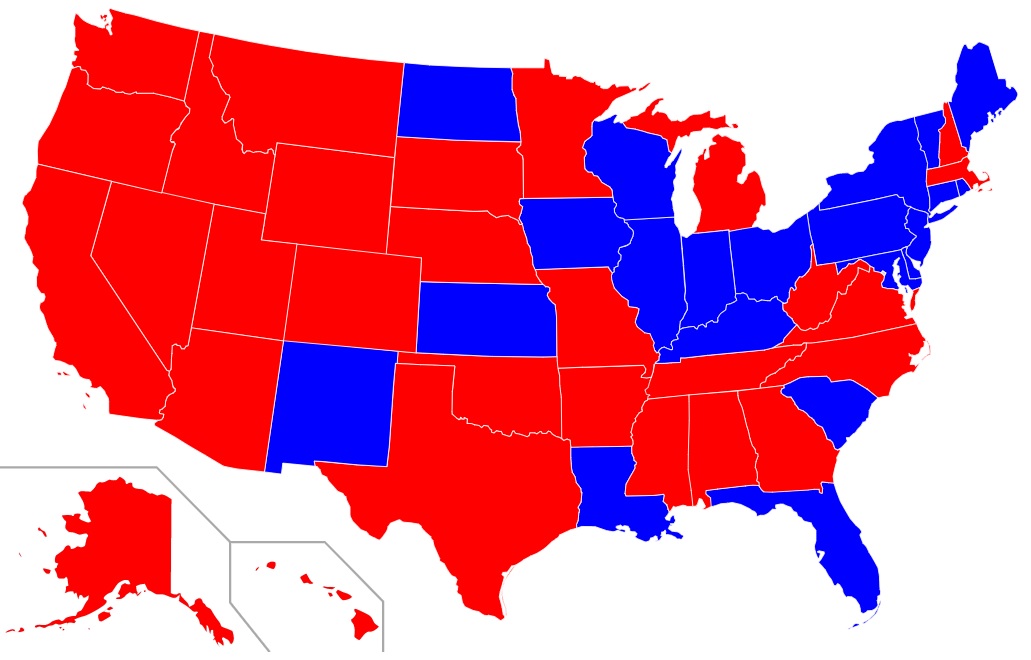
In the red states, the financial institution keeps the title to
your house and has a lien against the house until your
mortgage is paid off. In the blue states, you keep the title to
your house, but the financial institution still has a lien against
your house until your mortgage is paid off.
your house and has a lien against the house until your
mortgage is paid off. In the blue states, you keep the title to
your house, but the financial institution still has a lien against
your house until your mortgage is paid off.
Down Payment is the initial payment for purchasing the house. The average down payment amount for starter
home buyers falls somewhere between 5 and 10 percent (2017). For example, if you are going to purchase a
$300,000 home, you will have a down payment of between 5% - 10% or the purchase price or $15,000 to $30,000
down payment. As Mr. or Ms. Cheapo, you better start saving your money now.
home buyers falls somewhere between 5 and 10 percent (2017). For example, if you are going to purchase a
$300,000 home, you will have a down payment of between 5% - 10% or the purchase price or $15,000 to $30,000
down payment. As Mr. or Ms. Cheapo, you better start saving your money now.
You are ready to purchase your starter home (first home); however,
before you do, you MUST understand some basic real estate terminology.
before you do, you MUST understand some basic real estate terminology.

Add Monthly P + I + T + I
| Click on the blue box Monthly Schedule link above. If you do NOT do this, you will have difficulty finishing this lesson as you scroll down. |
Notice the column headings for the amortization schedule:
Payment Number
Beginning Balance (this is your monthly payment for Principal + Interest)
Interest (the amount of your monthly payment that goes to pay the interest)
Principal (the amount of your monthly payment that goes to pay down
the principal amount you borrowed)
Ending Balance (the amount you owe the bank as the months go by)
NOTE: The calculator DOES NOT include the down payment, real estate
taxes, or house insurance.
Payment Number
Beginning Balance (this is your monthly payment for Principal + Interest)
Interest (the amount of your monthly payment that goes to pay the interest)
Principal (the amount of your monthly payment that goes to pay down
the principal amount you borrowed)
Ending Balance (the amount you owe the bank as the months go by)
NOTE: The calculator DOES NOT include the down payment, real estate
taxes, or house insurance.
Notice as you scroll down the Monthly Amortization schedule, the following
things occur:
Beginning and Ending Balance keep going down by the amount of your
monthly payment.
Interest is still rather large in the beginning but falling.
Principal is still rather small in the beginning but rising.
The ending balance is the amount you would owe the bank if you were to
sell your home before paying off your mortgage. The difference between
the sales price of your home (minus closing costs) and what you owe the
bank is the equity you have built up in your home.
things occur:
Beginning and Ending Balance keep going down by the amount of your
monthly payment.
Interest is still rather large in the beginning but falling.
Principal is still rather small in the beginning but rising.
The ending balance is the amount you would owe the bank if you were to
sell your home before paying off your mortgage. The difference between
the sales price of your home (minus closing costs) and what you owe the
bank is the equity you have built up in your home.
Realize that if home market values climb, then you build up more equity in your
house. But, if home market values fall as they did during The Great Recession
then you lose more equity in your house.
house. But, if home market values fall as they did during The Great Recession
then you lose more equity in your house.
After 30 years, look at the Interest Total you have paid on your mortgage. This figure might shock you.
To figure your true monthly payment you must add your monthly payment (P + I) from the monthly calculator + real estate
Taxes + homeowner's Insurance.
Using the information below, calculate your monthly payment for your starter home.
To figure your true monthly payment you must add your monthly payment (P + I) from the monthly calculator + real estate
Taxes + homeowner's Insurance.
Using the information below, calculate your monthly payment for your starter home.
Embedded Websites: Smartasset.com https://smartasset.com/taxes/property-taxes#THzo6ScJsY
Search for a house on Zillow.com to see what houses cost in your neighborhood. Choose a house and go through the assignment above
and figure out what your monthly payment will be after your down payment. Then look at the amortization schedule and figure your TOTAL
monthly payment just like you did in your example of your starter home:
http://zillow.com
and figure out what your monthly payment will be after your down payment. Then look at the amortization schedule and figure your TOTAL
monthly payment just like you did in your example of your starter home:
http://zillow.com
- - - - - - - - - - - - - - - - - - - - - - - - - - - - - - - - - - - - - - - - - - - - - - - - - - - - - - - - - - - - - - - - - - - - - - - - - - - - - - - - - - - - - - - - - - - - - - - - - - - -

| Steven M. Reff Economics Lecturer University of Arizona (2007 - 2016) The 2015 University of Arizona Five-Star Faculty Award |
Click on button below to find the
average mortgage rate in your state.
REMEMBER THIS PERCENTAGE
NUMBER!
average mortgage rate in your state.
REMEMBER THIS PERCENTAGE
NUMBER!
After finding your state
average mortgage rate,
close the popup window
above.
average mortgage rate,
close the popup window
above.
- - - - - - - - - - - - - - - - - - - - - - - - - - - - -
Buying your first house:
Click the green Calculate button and see what your monthly P + I payment is.
Payment
Number
Number
Beginning
Balance
Balance
Interest
Principal
Ending
Balance
Balance
Your monthly P + I is the amount you pay each
month to your financial institution (bank). This
figure is found above in the green box that
states Monthly Pay.
month to your financial institution (bank). This
figure is found above in the green box that
states Monthly Pay.