Understanding Credit
Find a Co-Signer
A parent, a guardian, or a close relative might be an individual who can co-sign on a small
loan for you. By getting a co-signer, the financial institution knows that if you can't make
your payments then the person who co-signed becomes responsible for the payment(s).
Opening a Bank Account
After opening the bank account and having it for several months, the financial institution
can look at your account to see that you have an income flow coming into your account.
They might be willing to offer you a credit card with a low limit on it. Talk to your bank
representative when you open a bank account.
Secured Credit Cards
Secured credit cards require a cash deposit and then you can make monthly payments for
purchases, thus establishing credit.
Student Credit Cards
Financial institutions entice students to use their services by offering low credit limit on
the use of the credit card, but with higher interest rates because the student who has no
credit is a higher risk for them. If you use your credit card to try to establish credit,
remember it is your payments on time that matter most.
Auto Loan
Some used car dealerships will help you finance your car with a larger down payment to
customers who don't have a credit history. In many states if you even miss just one
payment, creditors will contact you with a notification of "right to cure." This means if
you miss a payment, the financial institution has a right to repossess the automobile.
A parent, a guardian, or a close relative might be an individual who can co-sign on a small
loan for you. By getting a co-signer, the financial institution knows that if you can't make
your payments then the person who co-signed becomes responsible for the payment(s).
Opening a Bank Account
After opening the bank account and having it for several months, the financial institution
can look at your account to see that you have an income flow coming into your account.
They might be willing to offer you a credit card with a low limit on it. Talk to your bank
representative when you open a bank account.
Secured Credit Cards
Secured credit cards require a cash deposit and then you can make monthly payments for
purchases, thus establishing credit.
Student Credit Cards
Financial institutions entice students to use their services by offering low credit limit on
the use of the credit card, but with higher interest rates because the student who has no
credit is a higher risk for them. If you use your credit card to try to establish credit,
remember it is your payments on time that matter most.
Auto Loan
Some used car dealerships will help you finance your car with a larger down payment to
customers who don't have a credit history. In many states if you even miss just one
payment, creditors will contact you with a notification of "right to cure." This means if
you miss a payment, the financial institution has a right to repossess the automobile.
A little while after you have established credit, you will have a credit score.
The three major credit bureaus are:
Equifax - www.equifax.com
P.O. Box 740241
Atlanta, GA 30374-0241
1-800-685-1111
Experian - www.experian.com
P.O. Box 2104
Allen, TX 75013-0949
1-888-EXPERIAN (397-3742)
TransUnion - www.transunion.com
P.O. Box 1000
Chester, PA 19022
1-800-916-8800
These organizations gather consumer credit information and then sell this information
to other businesses (credit report). Once you have established some credit, each of
these major credit bureaus will have a FICO score for you.
(NOTE: FICO is not a credit bureau; FICO is the score you receive from a credit bureau.)
The three major credit bureaus are:
Equifax - www.equifax.com
P.O. Box 740241
Atlanta, GA 30374-0241
1-800-685-1111
Experian - www.experian.com
P.O. Box 2104
Allen, TX 75013-0949
1-888-EXPERIAN (397-3742)
TransUnion - www.transunion.com
P.O. Box 1000
Chester, PA 19022
1-800-916-8800
These organizations gather consumer credit information and then sell this information
to other businesses (credit report). Once you have established some credit, each of
these major credit bureaus will have a FICO score for you.
(NOTE: FICO is not a credit bureau; FICO is the score you receive from a credit bureau.)
- - - - - - - - - - - - - - - - - - - - - - - - - - - - - - - - - - - - - - - - - - - - - - - - - - - - - - - - - - - - - - - -
- - - - - - - - - - - - - - - - - - - - - - - - - - - - - - - - - - - - - - - - - - - - - - - - - - - - - - - - - - - - - - - - -
- - - - - - - - - - - - - - - - - - - - - - - - - - - - - - - - - - - - - - - - - - - - - - - - - - - - - - - - - - - - - - - - - -
- - - - - - - - - - - - - - - - - - - - - - - - - - - - - - - - - - - - - - - - - - - - - - - - - - - - - - - - - - - - - - - - - -
- - - - - - - - - - - - - - - - - - - - - - - - - - - - - - - - - - - - - - - - - - - - - - - - - - - - - - - - - - - - - - - - - - - - -
According to the Fair Isaac Corporation that calculates the popular “FICO score,"
the following factors (and weighting) determine your credit score.
• Payment History (35%) -- includes account payment information, bankruptcy
or judgments, how long overdue payments are, amount past due, and the time since
any adverse occurrences.
• Amounts Owed (30%) -- includes the amounts owed on accounts individually and
totaled together as a whole,number of accounts with balances, proportion of
credit line used and proportion of installment loan amounts still owed.
• Length of Credit History (15%) -- includes the time since you accounts have been
open as well as the time since your accounts have been active.
• New Credit (10%) -- includes the number of and time since recently opened accounts
and proportion to total accounts, number of and time since recent credit inquires,
and the re-establishment of positive credit history following past payment problems.
• Types of Credit Used (10%) -- includes the number of various types of accounts,
like credit cards, retail accounts, installment loans, mortgage, etc.
the following factors (and weighting) determine your credit score.
• Payment History (35%) -- includes account payment information, bankruptcy
or judgments, how long overdue payments are, amount past due, and the time since
any adverse occurrences.
• Amounts Owed (30%) -- includes the amounts owed on accounts individually and
totaled together as a whole,number of accounts with balances, proportion of
credit line used and proportion of installment loan amounts still owed.
• Length of Credit History (15%) -- includes the time since you accounts have been
open as well as the time since your accounts have been active.
• New Credit (10%) -- includes the number of and time since recently opened accounts
and proportion to total accounts, number of and time since recent credit inquires,
and the re-establishment of positive credit history following past payment problems.
• Types of Credit Used (10%) -- includes the number of various types of accounts,
like credit cards, retail accounts, installment loans, mortgage, etc.
Investopedia defines bank credit as "an agreement between banks and borrowers where
banks trust a borrower to repay funds plus interest for either a loan, credit card or line of
credit at a later date."
To get credit, you have to have a credit history. What? That's right. If you don't have a
credit history, then you can't get credit.
So what are some ways to get credit without having a credit history?
banks trust a borrower to repay funds plus interest for either a loan, credit card or line of
credit at a later date."
To get credit, you have to have a credit history. What? That's right. If you don't have a
credit history, then you can't get credit.
So what are some ways to get credit without having a credit history?
Several Methods of Establishing Credit (according to Debt.org)
- - - - - - - - - - - - - - - - - - - - - - - - - - - - - - - - - - - - - - - - - - - - - - - - - - - - - - - - - - - - - - - - - - -
The Three Major Credit Bureaus
How is Your FICO Score Calculated?
Figuring Your FICO Score (Estimation Calculators)
Credit Card Minimum Payment Calculator)
Credit card debt occurs for one reason and one reason only. You don't pay your credit
card balance offwhen the bill comes due. Any time you do not pay off your credit card
balance, you credit card debt.
Paying the MINIMUM amount due each month only allows you to continue to use your
credit card. What this does, though, is put you into credit card debt.
Play with the calculator below (from bankrate.com) and see how much you owe your
financial institutionbecause you decide to pay only the MINIMUM amount due.
card balance offwhen the bill comes due. Any time you do not pay off your credit card
balance, you credit card debt.
Paying the MINIMUM amount due each month only allows you to continue to use your
credit card. What this does, though, is put you into credit card debt.
Play with the calculator below (from bankrate.com) and see how much you owe your
financial institutionbecause you decide to pay only the MINIMUM amount due.
Final Note
Credit is NOT money. If a credit card were money, it would be called a money card.
Credit is given to you with a promise that you will pay back the borrowed amount
some time in the future. Credit is a way topurchase something today that you can pay
for some time in the future.
As you can see from the calculator above, you get yourself into credit trouble when
you don't make your full monthly payments each month.
Using credit for long-term purchases (house, automobile, education) has advantages.
When you pay off your house and automobile, you then truly own your house and car.
If you don't make your payments on your house or automobile, the financial institution
can foreclose on your house or repossess your car.
Your student loan for an education is an investment into your perceived future earnings.
Credit is given to you with a promise that you will pay back the borrowed amount
some time in the future. Credit is a way topurchase something today that you can pay
for some time in the future.
As you can see from the calculator above, you get yourself into credit trouble when
you don't make your full monthly payments each month.
Using credit for long-term purchases (house, automobile, education) has advantages.
When you pay off your house and automobile, you then truly own your house and car.
If you don't make your payments on your house or automobile, the financial institution
can foreclose on your house or repossess your car.
Your student loan for an education is an investment into your perceived future earnings.
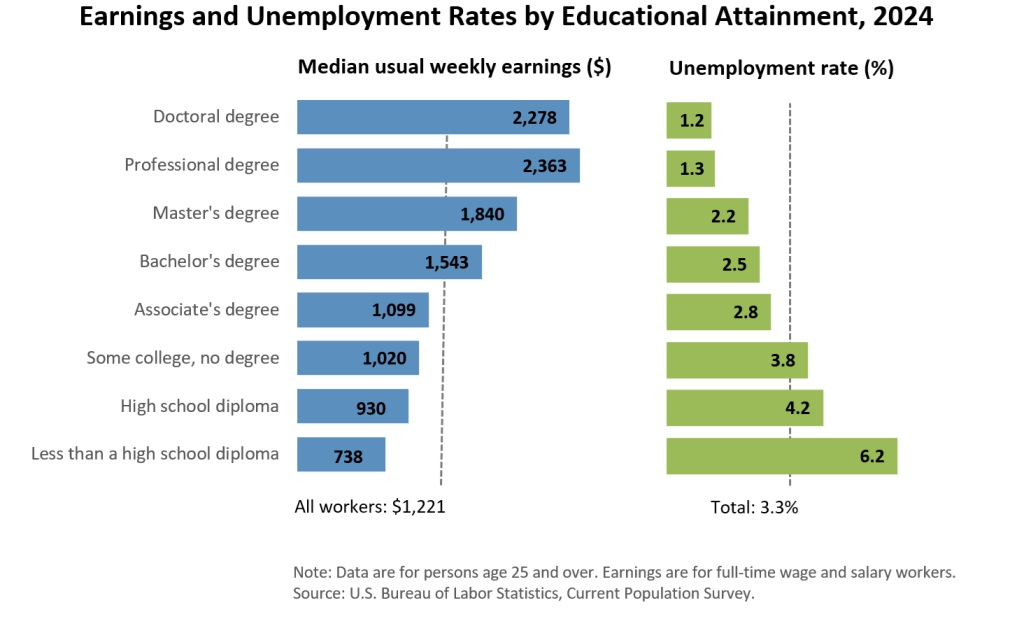
Using the calculator above,
figure the median YEARLY
earnings of each of the degree
attainments shown on the
Bureau of Labor Statistic graph
to the left by multiplying the
Median usual weekly earnings
times 52 weeks.
figure the median YEARLY
earnings of each of the degree
attainments shown on the
Bureau of Labor Statistic graph
to the left by multiplying the
Median usual weekly earnings
times 52 weeks.
The graph above shows the unemployment rate by degree attainment and median usual weekly
earnings by degree attainment. To attain higher degrees you must make yourself worse off in
the short run (giving up earnings today to get a degree) to make yourself better off in the long run
(future employment and future earnings).
If you take out a student loan for your education, make sure you work harder than you have ever
worked in your entire life and attain that degree. To take out a student loan and quit school a
year or two later can be a poor investment on borrowed money.
Best of luck making the right decisions on when and how to borrow money, but most importantly
pay off your debts before you retire. Life becomes a lot easier during your retirement years when
you have no debt.
earnings by degree attainment. To attain higher degrees you must make yourself worse off in
the short run (giving up earnings today to get a degree) to make yourself better off in the long run
(future employment and future earnings).
If you take out a student loan for your education, make sure you work harder than you have ever
worked in your entire life and attain that degree. To take out a student loan and quit school a
year or two later can be a poor investment on borrowed money.
Best of luck making the right decisions on when and how to borrow money, but most importantly
pay off your debts before you retire. Life becomes a lot easier during your retirement years when
you have no debt.

| Steven M. Reff Economics Lecturer University of Arizona (2007 - 2016) The 2015 University of Arizona Five-Star Faculty Award |
- - - - - - - - - - - - - - - - - - - - - - - - - - - - - - - - - - - - - - - - - - - - - - - - - - - - - - - - - - - - - - - - - - - - - - - - - -
My FICO Score:
https://www.myfico.com/fico-credit-score-estimator/estimator
https://www.myfico.com/fico-credit-score-estimator/estimator
Calcxml -- What is My Credit Score?
https://www.calcxml.com/calculators/credit-score-calculator-new
https://www.calcxml.com/calculators/credit-score-calculator-new
Simon Fitzgerald LLC -- Credit Score Calculator--What is My Credit Score?
https://www.simonfitzgerald.com/credit-score-calculator/
https://www.simonfitzgerald.com/credit-score-calculator/
Use one of the links below to help you understand how your credit score is calculated.
Because you are a young student, it might be difficult to come up with a correct credit
score for you, but it will give you a heads up on how important your credit score will
become when you start borrowing for a car, a home, or other assets you want to purchase
later in your life.
NOTE: Do NOT click on other links found inside these websites as these websites
should only be used to calculate your credit score.
Because you are a young student, it might be difficult to come up with a correct credit
score for you, but it will give you a heads up on how important your credit score will
become when you start borrowing for a car, a home, or other assets you want to purchase
later in your life.
NOTE: Do NOT click on other links found inside these websites as these websites
should only be used to calculate your credit score.
Click on this link: Bank.com