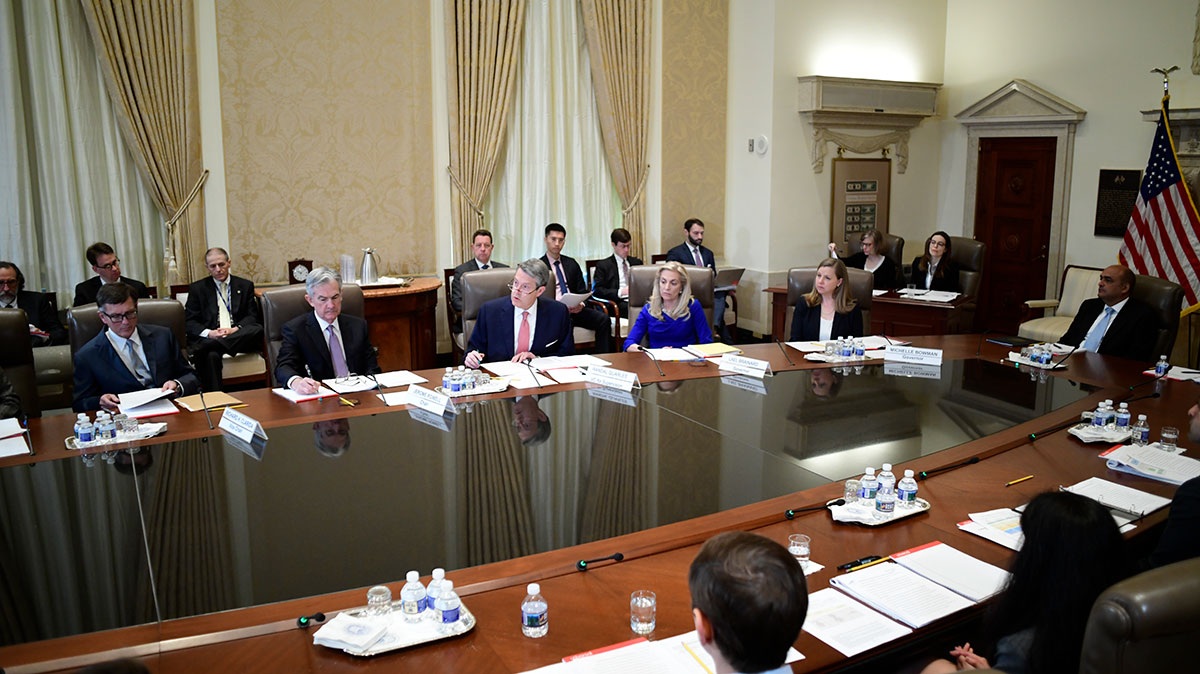
| The Federal Open Market Committee (FOMC) that meets 8 times each year. Remember this Committee also includes the members of the Board of Governors. |
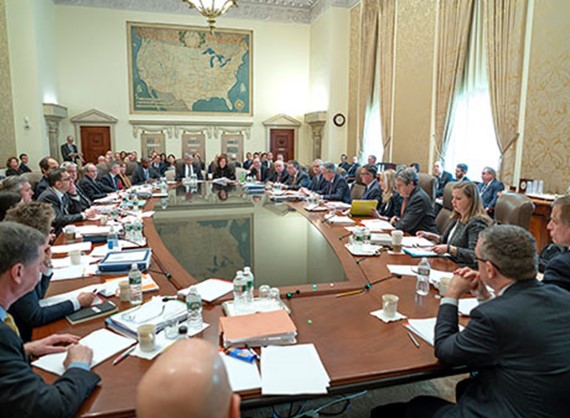
| The Board of Governors meet every other Monday. |
The interest rate on reserve balances (IORB rate) and the primary
credit rate (formerly known as the discount rate) are determined
by the FRB). IORB is the primary tool for the Federal Reserve's
monetary policy.
credit rate (formerly known as the discount rate) are determined
by the FRB). IORB is the primary tool for the Federal Reserve's
monetary policy.
The maximum number of governors who sit on The Board of
Governors of the Federal Reserve is 7 governors.
Notice above as of February 13, 2023 the Board had the maximum
number.
The members of the Board of Governors of the Federal Reserve
System are nominated by the President and confirmed
by the Senate. A full term is 14 years.
The Chair and the Vice Chair of the Board, as well as the Vice
Chair for Supervision, are nominated by the President from among
the members and are confirmed by the Senate. They serve a term
of four years.
Governors of the Federal Reserve is 7 governors.
Notice above as of February 13, 2023 the Board had the maximum
number.
The members of the Board of Governors of the Federal Reserve
System are nominated by the President and confirmed
by the Senate. A full term is 14 years.
The Chair and the Vice Chair of the Board, as well as the Vice
Chair for Supervision, are nominated by the President from among
the members and are confirmed by the Senate. They serve a term
of four years.

The maximum number of members who sit on the Federal Open
Market Committee (FOMC) consists of 12 members. Notice above
that the FOMC had this maximum number as of February 13:
7 members of the Board of Governors of the Federal Reserve
System as of February 13, 2023.
1 President of the Federal Reserve Bank of New York always
sits on the FOMC
4 of the remaining eleven Reserve Bank presidents, who serve
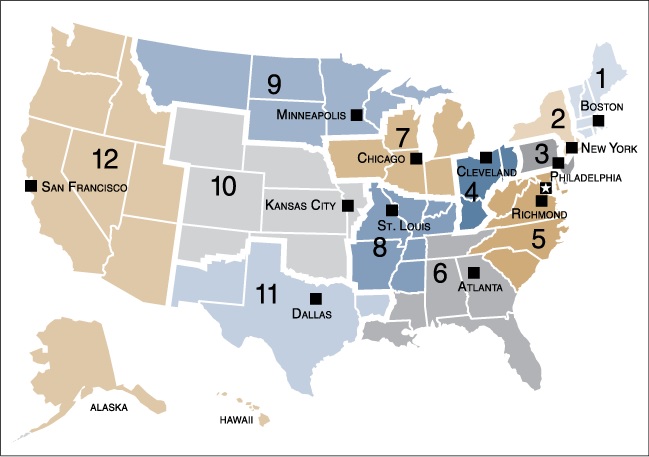
one-year terms on a rotating basis. (See district bank map below)
Market Committee (FOMC) consists of 12 members. Notice above
that the FOMC had this maximum number as of February 13:
7 members of the Board of Governors of the Federal Reserve
System as of February 13, 2023.
1 President of the Federal Reserve Bank of New York always
sits on the FOMC
4 of the remaining eleven Reserve Bank presidents, who serve
one-year terms on a rotating basis. (See district bank map below)
12 Federal Reserve District Bank Presidents
The New York Federal Reserve District Bank President and
4 Federal Reserve District Bank Presidents sit on the
Federal Open Market Committee (FOMC)
The remaining 7 Federal Reserve Bank Presidents attend
the FOMC meetings and bring their district board reports
to help advise The Board of Governors on the
Primary Credit Rate (formerly entitled the Discount Rate)
that should be administered. The Board of Governors
then makes the final decision on this rate.
The New York Federal Reserve District Bank President and
4 Federal Reserve District Bank Presidents sit on the
Federal Open Market Committee (FOMC)
The remaining 7 Federal Reserve Bank Presidents attend
the FOMC meetings and bring their district board reports
to help advise The Board of Governors on the
Primary Credit Rate (formerly entitled the Discount Rate)
that should be administered. The Board of Governors
then makes the final decision on this rate.
2023 Board of Governors of the Federal Reserve System (FRB)
• Jerome H. Powell, Board of Governors, Chair
• Michael S. Barr, Board of Governors, Vice Chair for Supervision
• Michelle W. Bowman, Board of Governors
• Lael Brainard, Board of Governors, Vice Chair
(resigned on February 14, 2023 to become the Director of the
National Economic Council at the White House)
• Lisa D. Cook, Board of Governors
• Philip N. Jefferson, Board of Governors
• Christopher J. Waller, Board of Governors
• Jerome H. Powell, Board of Governors, Chair
• Michael S. Barr, Board of Governors, Vice Chair for Supervision
• Michelle W. Bowman, Board of Governors
• Lael Brainard, Board of Governors, Vice Chair
(resigned on February 14, 2023 to become the Director of the
National Economic Council at the White House)
• Lisa D. Cook, Board of Governors
• Philip N. Jefferson, Board of Governors
• Christopher J. Waller, Board of Governors
The History of Ample Reserves Along with Everything Your Students Have to Know about Ample
Reserves for the May 2024 Exam in Conjunction with FEE.org:
https://reffonomics.com/firesidechatamplereserves.html
What is Covered on the May Exam in Macroeconomics?
https://reffonomics.com/amplereservesregime2023.html
AP Macroeconomics Lesson for BOTH Money Market and Ample Reserves Graphs
https://reffonomics.com/fed2023.html
Cell Phone Graphing Ample Reserves:
https://reffonomics.com/graphsmac4a.html
Reserves for the May 2024 Exam in Conjunction with FEE.org:
https://reffonomics.com/firesidechatamplereserves.html
What is Covered on the May Exam in Macroeconomics?
https://reffonomics.com/amplereservesregime2023.html
AP Macroeconomics Lesson for BOTH Money Market and Ample Reserves Graphs
https://reffonomics.com/fed2023.html
Cell Phone Graphing Ample Reserves:
https://reffonomics.com/graphsmac4a.html
| The Federal Open Market Committee (FOMC), the Board of Governors, and the 12 District Bank Presidents |
2023 Federal Open Market Committee (FOMC) Committee Members
• Jerome H. Powell, Board of Governors, Chair
• Michael S. Barr, Board of Governors
• Michelle W. Bowman, Board of Governors
• Lael Brainard, Board of Governors (resigned February 14)
• Lisa D. Cook, Board of Governors
• Philip N. Jefferson, Board of Governors
• Christopher J. Waller, Board of Governors
• John C. Williams, New York, Vice Chair
• James Bullard, St. Louis
• Susan M. Collins, Boston
• Esther L. George, Kansas City
• Loretta J. Mester, Cleveland
• Jerome H. Powell, Board of Governors, Chair
• Michael S. Barr, Board of Governors
• Michelle W. Bowman, Board of Governors
• Lael Brainard, Board of Governors (resigned February 14)
• Lisa D. Cook, Board of Governors
• Philip N. Jefferson, Board of Governors
• Christopher J. Waller, Board of Governors
• John C. Williams, New York, Vice Chair
• James Bullard, St. Louis
• Susan M. Collins, Boston
• Esther L. George, Kansas City
• Loretta J. Mester, Cleveland
| 2019 (January) |
| Monetary Policy -- Ample Reserves Regime is Here to Stay |


The Board of Governors of the Federal Reserve System and the Federal Open
Market Committee (FOMC) shall maintain long-run growth of the monetary and
credit totals proportionate with the economy's long-run potential to increase
production, so as to promote effectively the goals of:
Maximum Employment
Stable Prices
Moderate Long-Term Interest Rates
The "Dual Mandate" is to maintain Maximum Employment and Stable Prices.
Market Committee (FOMC) shall maintain long-run growth of the monetary and
credit totals proportionate with the economy's long-run potential to increase
production, so as to promote effectively the goals of:
Maximum Employment
Stable Prices
Moderate Long-Term Interest Rates
The "Dual Mandate" is to maintain Maximum Employment and Stable Prices.
On the Dual Mandate Bullseye below, shown on the y axis is the inflation rate determined by the Personal Consumption
Expenditure Index, an inflation index used by the Federal Reserve. The targeted inflation rate by the FOMC is 2% (stable
prices). Shown on the x axis is the unemployment rate. The bullseye indicates where the Natural Rate of Unemployment
(maximum employment) lies at a certain period of time.
Expenditure Index, an inflation index used by the Federal Reserve. The targeted inflation rate by the FOMC is 2% (stable
prices). Shown on the x axis is the unemployment rate. The bullseye indicates where the Natural Rate of Unemployment
(maximum employment) lies at a certain period of time.
| To use the interactive Dual Mandate Bullseye follow the directions underneath the graph. |
| 1977 (November) |
| The Federal Reserve Act of 1977 (Dual Mandate) |
| The Present (10 minutes) |
| The REFF® and FRED® Graphs |
| The REFF® AR Graph |
| Money Market Graph Rip It Out! Simple Money Multiplier (1/RR) Rip It Out! |
| next to a FRED® graph. |
PL
PLc
"Effective July 27, 2023, the Federal Open Market Committee (FOMC) directs the Desk to:
Undertake open market operations as necessary to maintain the federal funds rate in a target range of 5-1/4 to 5-1/2 percent.
Undertake open market operations as necessary to maintain the federal funds rate in a target range of 5-1/4 to 5-1/2 percent.
PLf
When the FOMC raises the target range, banks increase their
lending rates for borrowers (including other banks), making
credit more expensive and savings accounts more lucrative.
Undertake open market operations as necessary to maintain
the Federal Funds Rate in a target range of 5-1/4 to 5-1/2
percent.
The Federal Funds Rate is a POLICY RATE. It is the
rate that banks charge other banks for borrowing overnight.
lending rates for borrowers (including other banks), making
credit more expensive and savings accounts more lucrative.
Undertake open market operations as necessary to maintain
the Federal Funds Rate in a target range of 5-1/4 to 5-1/2
percent.
The Federal Funds Rate is a POLICY RATE. It is the
rate that banks charge other banks for borrowing overnight.
| Teach the Differences Among |
PL
| The Future (30 minutes) |
| The Money Supply -- Rip It Out! |
Administered Rate #1: "The Board of Governors of the Federal Reserve System voted unanimously to raise the
Interest Rate on Reserve Balances (IOR) to 5.4 percent, effective July 27, 2023."
Interest Rate on Reserve Balances (IOR) to 5.4 percent, effective July 27, 2023."
i
The Policy Rate is the Federal Funds Rate.
i1
Shown below are 3 Administered Rates that influence the Policy Rate (Federal Funds Rate) to remain
within the target range.
within the target range.
i1
Administered Rate #3: "The FOMC directs the desk to: Conduct standing Overnight Reverse Repurchase Agreement (ON RRP)
operations at an offering rate of 5.3 percent and with a per-counterparty limit of $160 billion per day."
operations at an offering rate of 5.3 percent and with a per-counterparty limit of $160 billion per day."
| February 2021 Senate Banking Committee on the Semiannual Monetary Policy Report |
up
Administered Rate #2: "In a related action, the Board of Governors of the Federal Reserve System voted unanimously to
approve a 1/4 percentage point increase in the Primary Credit Rate to 5.5 percent, effective July 27, 2023."
In the action above, the Board approved requests to establish that rate submitted by the Boards of Directors of the Federal
Reserve Banks of Boston, Philadelphia, Cleveland, Richmond, Chicago, St. Louis. Minneapolis, Kansas City, Dallas, and
San Francisco.
approve a 1/4 percentage point increase in the Primary Credit Rate to 5.5 percent, effective July 27, 2023."
In the action above, the Board approved requests to establish that rate submitted by the Boards of Directors of the Federal
Reserve Banks of Boston, Philadelphia, Cleveland, Richmond, Chicago, St. Louis. Minneapolis, Kansas City, Dallas, and
San Francisco.
Within the first 24 seconds, Jerome Powell,
the Chairman of the Federal Reserve,
explainsthe difference between the Debt
and Deficit to Congressman John Kennedy
from Louisana, and then moves on to the
most important discussion of money -- M2.
the Chairman of the Federal Reserve,
explainsthe difference between the Debt
and Deficit to Congressman John Kennedy
from Louisana, and then moves on to the
most important discussion of money -- M2.
Interest Rate on Reserve Balances (IOR) is the MOST IMPORTANT TOOL OF MONETARY POLICY!
down
Students will NOT be tested on interest paid on Overnight Reverse Repurchase Agreement (ON RRP); however, they should
have the ability to marginally understand that the FED works with counter parties to increase or decrease reserves.
have the ability to marginally understand that the FED works with counter parties to increase or decrease reserves.
NIR
Primary credit is priced relative to the FOMC’s
target range for the federal funds rate and is
normally granted on a “no-questions-asked,”
minimally administered basis. There are no
restrictions on borrowers’ use of primary credit.
On March 15, 2020, the Federal Reserve announced
changes to primary credit. These changes included
the following:
Narrowing the spread of the primary credit rate
relative to the general level of overnight interest rates
to help encourage more active use of the window by
depository institutions to meet unexpected funding
needs.
Announcing that depository institutions may borrow
from the discount window for periods as long as 90
days, prepayable and renewable by the borrower on a
daily basis.
target range for the federal funds rate and is
normally granted on a “no-questions-asked,”
minimally administered basis. There are no
restrictions on borrowers’ use of primary credit.
On March 15, 2020, the Federal Reserve announced
changes to primary credit. These changes included
the following:
Narrowing the spread of the primary credit rate
relative to the general level of overnight interest rates
to help encourage more active use of the window by
depository institutions to meet unexpected funding
needs.
Announcing that depository institutions may borrow
from the discount window for periods as long as 90
days, prepayable and renewable by the borrower on a
daily basis.
Simple Review
The target range (lower limit) and target range (upper
limit) are NOT shown on the graph to the left.
The green line is the Federal Funds Rate which is the
POLICY RATE.
Administered Rate #1: The MOST IMPORTANT
administered tool of Monetary Policy is Interest paid on
Reserve Balances (IOR).
Administered Rate #2: Primary Credit Rate which is a
ceiling rate and is equal to the FOMC target range
upper limit.
Administered Rate #3: Interest paid on Overnight
Reverse Repurchase Agreements (ON RRP). Students
will NOT be tested on this concept in 2024.
The target range (lower limit) and target range (upper
limit) are NOT shown on the graph to the left.
The green line is the Federal Funds Rate which is the
POLICY RATE.
Administered Rate #1: The MOST IMPORTANT
administered tool of Monetary Policy is Interest paid on
Reserve Balances (IOR).
Administered Rate #2: Primary Credit Rate which is a
ceiling rate and is equal to the FOMC target range
upper limit.
Administered Rate #3: Interest paid on Overnight
Reverse Repurchase Agreements (ON RRP). Students
will NOT be tested on this concept in 2024.
| Expansionary Monetary Policy Flow Chart with REFF® AR GRAPH and ASAD GRAPH. |
| Required Reserves Rip It Out! Excess Reserves Rip It Out! Commercial Bank Balance Sheet Rip It Out! |
| Contractionary Monetary Policy Flow Chart with REFF® AR GRAPH and ASAD GRAPH. |
The Federal Reserve is the lender of last resort through the
Federal Reserve of New York's Discount Window:
The Primary Credit Rate, formerly called the Discount Rate
until 2003, serves as the principal safety valve for ensuring
adequate liquidity in the banking system. It is available to
depository institutions that are in generally sound financial
condition, and there are no restrictions on the use of funds
borrowed under primary credit.
Secondary Credit Rate is available to depository institutions
not eligible for primary credit. Secondary credit entails a higher
level of administration. In April of 2023, the Federal Reserve
stated the secondary credit rate would be 50 basis points
above the primary credit rate.
Seasonal Credit is available to assist small depository
institutions with demonstrated liquidity pressures of a
seasonal nature and will not normally be available to
institutions with deposits of $500 million or more. The
seasonal credit rate is reset every two weeks as the
average of the daily effective federal funds rate.
Federal Reserve of New York's Discount Window:
The Primary Credit Rate, formerly called the Discount Rate
until 2003, serves as the principal safety valve for ensuring
adequate liquidity in the banking system. It is available to
depository institutions that are in generally sound financial
condition, and there are no restrictions on the use of funds
borrowed under primary credit.
Secondary Credit Rate is available to depository institutions
not eligible for primary credit. Secondary credit entails a higher
level of administration. In April of 2023, the Federal Reserve
stated the secondary credit rate would be 50 basis points
above the primary credit rate.
Seasonal Credit is available to assist small depository
institutions with demonstrated liquidity pressures of a
seasonal nature and will not normally be available to
institutions with deposits of $500 million or more. The
seasonal credit rate is reset every two weeks as the
average of the daily effective federal funds rate.
| REFFONOMICS® BASEBALL -- Ample Reserves Regime |

| The FED starts paying Interest on required and excess reserves |
| Reffonomics.com Useful Links for Understanding Ample Reserves Regime |
| 2008 (October) |
| The "Discount Rate" is DISCONTINUED and replaced by the "Primary Credit Rate" |
| Expansionary Monetary Policy Flow Chart with REFF® AR GRAPH and ASAD GRAPH. |
| 2003 (January) |
| Contractionary Monetary Policy Flow Chart with REFF® AR GRAPH and ASAD GRAPH. |
| Expansionary Monetary Policy Flow Chart with REFF® AR GRAPH and ASAD GRAPH. |
| For AP® Macroeconomics Educators and Students: |
Below is a short video from The Dead Poets Society starring Robin Williams where he instructs his students
to rip out pages from their poetry book which should happen to many of the pages in economics textbooks
that relate to monetary policy of the past. Also, it is quite ironic that Robin Williams draws a graph about
poetry on the blackboard, as graphs tell important stories in economics.
to rip out pages from their poetry book which should happen to many of the pages in economics textbooks
that relate to monetary policy of the past. Also, it is quite ironic that Robin Williams draws a graph about
poetry on the blackboard, as graphs tell important stories in economics.
DO NOT USE THE TERM DISCOUNT RATE ANYMORE.
INSTEAD, USE THE TERM PRIMARY CREDIT RATE
THOUGH THE DISCOUNT WINDOW.
INSTEAD, USE THE TERM PRIMARY CREDIT RATE
THOUGH THE DISCOUNT WINDOW.

| The Past (10 minutes) |
| Ample Reserves Regime -- The Past, The Present, and The Future |
| September 19 - 20, 2023 FOMC Statement and Board of Governors' Press Release Lesson |
Every time you hear the terms Poem,
Poetry, or J. Evans Pritchard, say to
yourself -- OLD Monetary Policy.
Poetry, or J. Evans Pritchard, say to
yourself -- OLD Monetary Policy.
Before April 24, 2020, savings accounts were
not part of M1. Limitations in the number of
transfers from savings deposits made savings
accounts less liquid than M1. M1 consisted of
currency, demand deposits, and other highly
liquid accounts called “other checkable
deposits” (OCDs).
But the limitation on the number of these
transfers was lifted on April 24 as an
amendment to Regulation D, which specifies
how banks must classify deposit accounts.
Savings deposits are now just as liquid and
convenient as currency, demand deposits,
and OCDs.
not part of M1. Limitations in the number of
transfers from savings deposits made savings
accounts less liquid than M1. M1 consisted of
currency, demand deposits, and other highly
liquid accounts called “other checkable
deposits” (OCDs).
But the limitation on the number of these
transfers was lifted on April 24 as an
amendment to Regulation D, which specifies
how banks must classify deposit accounts.
Savings deposits are now just as liquid and
convenient as currency, demand deposits,
and OCDs.
A special thank you goes to The Council for Economics Education (CEE) for accepting my proposal to speak at the
62nd Financial Literacy & Economic Education Conference in Fort Lauderdale, Florida.
62nd Financial Literacy & Economic Education Conference in Fort Lauderdale, Florida.

| New Current Event Lessons Covering FOMC Meetings: |
| The FED starts paying INTEREST ON RESERVE BALANCES (IOR). This becomes the PRIMARY TOOL OF MONETARY POLICY. The FED, thus discontinues paying interest on required reserves (RR) and interest on ER on this date. |
| 2021 (August) |