| Steven M. Reff Economics Lecturer University of Arizona (2007 - 2016) The 2015 University of Arizona Five-Star Faculty Award |
eVideo Book -- Chapter 24:
eReading Assignments -- Chapter 24:
- - - - - - - - - - - - - - - - - - - - - - - - - - - - - - - - - - - - - - - -
| Standard 13: Monetary Policy, Part II -- The Federal Reserve (1913 - Present) |
| Use a map of the Federal Reserve System to determine the district where you live and the location of their Federal Reserve Bank. Use paper currency to identify which Federal Reserve Bank issued that bill. |
| Discuss the importance of the Fed’s role in the payments system. |
Video link 2: Video of how Fedwire Works
(2:40 minutes)
Video link 1: Video of the Difference between -- Fedwire and FedNow
(57 seconds)
| The Federal Reserve System is composed of three entities: the Federal Reserve Board of Governors, which oversees all aspects of the Federal Reserve; the 12 Federal Reserve Banks, which examine and supervise financial institutions, act as lenders of last resort, and provide U.S. payments system services; and the Federal Open Market Committee (FOMC), which is responsible for determining U.S. monetary policy. |
- - - - - - - - - - - - - - - - - - - - - - - - - - - - - - - - - - - - - - - - - - - -
| Week 13: History of Money & the Federal Reserve |
| Estimated Learning Time: 4 to 5 class periods (45 min. each) |
- - - - - - - - - - - - - - - - - - - - - - - - - - - - - - - - - - - - - - - - - - - -
| Activity 2: Contractionary and Expansionary Policy Graph (1983- 1993) |
Directions:
1) Press the Expansionary button and then yellow button #1 for an explanation.
2) Press the Contrationary button and then the yellow buttons #2 and 3 for an explanation.
1) Press the Expansionary button and then yellow button #1 for an explanation.
2) Press the Contrationary button and then the yellow buttons #2 and 3 for an explanation.
| Standard 13: Monetary Policy, Part IV -- History Limited Reserves Framework (1913 - 2008) |
Alan Greenspan stated that M2 (the money supply is no longer used as a leading economics
indicator in monetary policy. In 1990, the Conference Board omitted the real money supply.
indicator in monetary policy. In 1990, the Conference Board omitted the real money supply.
| 1993 |
10 Components of the Coincident Economic Index®
Average weekly hours in manufacturing
Average weekly initial claims for unemployment insurance
Manufacturers’ new orders for consumer goods and materials
ISM® Index of New Orders
Manufacturers’ new orders for nondefense capital goods - aircraft orders)
Building permits for new private housing units
S&P 500® Index of Stock Prices
Leading Credit Index™
Interest rate spread (10-year Treasury bonds less federal funds rate)
Average consumer expectations for business conditions
4 Components of the Coincident Economic Index®
Payroll employment
Personal income less transfer payments
Manufacturing and trade sales
Industrial production
Average weekly hours in manufacturing
Average weekly initial claims for unemployment insurance
Manufacturers’ new orders for consumer goods and materials
ISM® Index of New Orders
Manufacturers’ new orders for nondefense capital goods - aircraft orders)
Building permits for new private housing units
S&P 500® Index of Stock Prices
Leading Credit Index™
Interest rate spread (10-year Treasury bonds less federal funds rate)
Average consumer expectations for business conditions
4 Components of the Coincident Economic Index®
Payroll employment
Personal income less transfer payments
Manufacturing and trade sales
Industrial production


| 1986 |
In 1989, I purchased this 800-page book about the Fed's monetary policy before the
Internet became publicly available in 1993. I figured it would be easier to find
information from this book, Secrets of the Temple, than to go to the library, look
inside the index file (Dewey Decimal), go up the elevator to the stacks (of books)
on four different floors, find the book, find the page, find the paragraph, and come
up empty handed. Finding current economics information was very difficult to
come by back in 1986, when this book was published.
Back then I didn't know if the money supply was M1 or M2. Even after reading the
book, I never had a clear answer. But, what I did find on pages 724 - 726 inside the
appendix was information on the rate of growth in the money supply and the inflation
rates from 1979 - 1986.
Internet became publicly available in 1993. I figured it would be easier to find
information from this book, Secrets of the Temple, than to go to the library, look
inside the index file (Dewey Decimal), go up the elevator to the stacks (of books)
on four different floors, find the book, find the page, find the paragraph, and come
up empty handed. Finding current economics information was very difficult to
come by back in 1986, when this book was published.
Back then I didn't know if the money supply was M1 or M2. Even after reading the
book, I never had a clear answer. But, what I did find on pages 724 - 726 inside the
appendix was information on the rate of growth in the money supply and the inflation
rates from 1979 - 1986.
| U.S. Leading Economics Indicators (2025) |
| The History of the Money Supply. Today, Bank Reserves are FAR more important! |
| Standard 13: Monetary Policy, Part I -- The Topic of Money |
| "The topic of money—including its definition, functions, and role in the economy—is generally taught alongside monetary policy in on-level high school economics." Ask Google AI 1 |
eInteractive Activities -- Chapter 23:
(3:03 minutes)
(Make sure you take the 3 multiple choice questions underneath the video.)
eVideo Book -- Chapter 23:
eReading Assignments -- Chapter 23:
Is cryptocurrencies considered to be money today? No. Why?
Remember, money is "anything that is generally acceptable in exchange for goods and service."
Remember, money is a medium of exchange.
When was the last time you ever saw cyptocurrency used in the exchange of goods or services.
Cryptocurrency is a financial asset at this point in time, and is not considered to be money.
Remember, money is "anything that is generally acceptable in exchange for goods and service."
Remember, money is a medium of exchange.
When was the last time you ever saw cyptocurrency used in the exchange of goods or services.
Cryptocurrency is a financial asset at this point in time, and is not considered to be money.
| Even in 2021, the Chairman of the Federal Reserve, Jerome Powell, had a conversation with Senator John Kennedy from Louisiana, that the money supply should be unlearned. (1:30 minutes) |
| "Money (M2) . . . does not really have important implications for the economic outlook." |
- - - - - - - - - - - - - - - - - - - - - - - - - - - - - - - - - - - - - - - - - - - -
| Standard 13: Monetary Policy III -- Fed's Dual Mandate (1978 - Present) |
| "The Federal Reserve's Dual Mandate consists of two primary goals for the U.S. economy, as established by Congress in the Full Employment and Balanced Growth Act of 1978 (also known as the Humphrey-Hawkins Act): Twice a year, the Chair of the Federal Reserve appears before Congress to deliver the Semiannual Monetary Policy Report and provide formal testimony on the state of the U.S. economy. Maximum Employment: Promoting a strong labor market where everyone who wants a job can find one. The Fed does not have a fixed numerical target for this, as it changes over time based on non-monetary factors like demographics and technology. Stable Prices: Keeping inflation low and predictable so that people and businesses can make long-term financial plans without worrying about sudden price changes. The Fed generally interprets this as a 2% annual inflation rate over the long run." Ask Google AI 3 |
eReading Assignments -- Chapter 25:
- - - - - - - - - - - - - - - - - - - - - - - - - - - - - - - - - - - - - - - -
Inside the link above you learned the target inflation rate for the Fed is 2%.
| Explain why that target is better than a 10% target. |
The Rule of 72 is a simple formula that estimates the number of years it takes for something to double if
the interest rate remains at the same percentage over time. To use the calculator, divide 72 by the rate
(without the percentage).
the interest rate remains at the same percentage over time. To use the calculator, divide 72 by the rate
(without the percentage).
Explain why a 2% target rate is better than a 10% inflation rate?
Rule of 72
Using the Rule of 72
calculator to the right, plug
in $100 and use a rate of
return of 5% (plugging in
just the number 5), and if
interest rate remains
constant at 5% you will see
that the $100 will turn into
nearly $200 in how many
years?
calculator to the right, plug
in $100 and use a rate of
return of 5% (plugging in
just the number 5), and if
interest rate remains
constant at 5% you will see
that the $100 will turn into
nearly $200 in how many
years?
Using the Rule of 72
calculator to the left, plug
in $100 and use an inflation
rate of 10% (plugging in
just the number 10), and if
interest rate remains
constant at 2% you will see
that the $100 will turn into
nearly $200 in how many
years?
calculator to the left, plug
in $100 and use an inflation
rate of 10% (plugging in
just the number 10), and if
interest rate remains
constant at 2% you will see
that the $100 will turn into
nearly $200 in how many
years?
"When households and businesses can reasonably expect 2 percent inflation over the longer run,
they are better able to make sound decisions regarding saving, borrowing, and investment, which
contribute to a well-functioning economy and the well-being of all Americans." 1
they are better able to make sound decisions regarding saving, borrowing, and investment, which
contribute to a well-functioning economy and the well-being of all Americans." 1
Using the Rule of 72 calculator above, if an annual target inflation rate for the Fed is
2% over the long run, how long would it take for prices to double.
2% over the long run, how long would it take for prices to double.
Within the activities below, you will be seeing graphs during this period of time that include two out of
the three tools of monetary policy -- Open Market Operations (OMO) and the Discount Rate (DR) which
transitioned in 2003 to become the Primary Credit Rate (PCR).
Open Market Operations involves the buying and selling of government securities (bonds) and was the
main tool of monetary policy during this period of time. If the FOMC decides to buy or purchase
government securities (bonds), this shifts the supply of reserves to the right, ultimately lowering the
Federal Funds Target Rate (FFR).
If the FOMC decides to sell bonds (contractionary monetary policy), this shifts the supply of reserves to
the left, ultimately raising the Federal Funds Target Rate (FFR). The Federal Funds Target Rate (FFR),
which is a policy rate is determined in the market for these funds.
A Limited Reserves framework occurs when a central bank actively manages the supply of reserves
through the buying and selling of government securities to influence the Federal Funds TARGET RATE
(FFR).
Also in a Limited Reserves framework, the central bank uses contractionary monetary policy by using
open market operations by selling government securities (bonds) to commercial banks to reduce the
supply of reserves which raises the FFR, or the central bank uses expansionary monetary policy by using
open market operations by buying (purchasing) government securities (bonds) to commercial banks to
increase the supply of reserves which lowers the FFR. This framework was the norm before the Federal
Reserve shifted to an ample-reserves model after the 2008 financial crisis.
the three tools of monetary policy -- Open Market Operations (OMO) and the Discount Rate (DR) which
transitioned in 2003 to become the Primary Credit Rate (PCR).
Open Market Operations involves the buying and selling of government securities (bonds) and was the
main tool of monetary policy during this period of time. If the FOMC decides to buy or purchase
government securities (bonds), this shifts the supply of reserves to the right, ultimately lowering the
Federal Funds Target Rate (FFR).
If the FOMC decides to sell bonds (contractionary monetary policy), this shifts the supply of reserves to
the left, ultimately raising the Federal Funds Target Rate (FFR). The Federal Funds Target Rate (FFR),
which is a policy rate is determined in the market for these funds.
A Limited Reserves framework occurs when a central bank actively manages the supply of reserves
through the buying and selling of government securities to influence the Federal Funds TARGET RATE
(FFR).
Also in a Limited Reserves framework, the central bank uses contractionary monetary policy by using
open market operations by selling government securities (bonds) to commercial banks to reduce the
supply of reserves which raises the FFR, or the central bank uses expansionary monetary policy by using
open market operations by buying (purchasing) government securities (bonds) to commercial banks to
increase the supply of reserves which lowers the FFR. This framework was the norm before the Federal
Reserve shifted to an ample-reserves model after the 2008 financial crisis.
In a Limited Reserves framework, banks hold their required reserves at the Federal Reserve or inside their
vaults and then use the excess reserves for lending and purchasing government securities and other
financial assets to earn interest on these excess reserves.
vaults and then use the excess reserves for lending and purchasing government securities and other
financial assets to earn interest on these excess reserves.
| Activity 3: Slide Show Activity for Learning about Limited Reserves |
| 1978 - Present |
| 1913 - Present |
| 1913 - 2003 |
- - - - - - - - - - - - - - - - - - - - - - - - - - - - - - - - - - - - - - - - - - - -
| Activity 1: A Standalone Limited Reserves Graph (1983- 1993) |
Directions:
1) Click or press on the yellow circled numbers located ON the FRED
graph below and the FFR, DR, and answer button will show below.
2) Take your cursor and drag it along the black line (DR) and see how the
numbers below match up with the numbers on the FRED graph.
3) On the graph to the left, move the supply of reserves (Sr1) to the
approprate spot and move the DR=PCR to the appropriate spot.
NOTE: DR stands for Discount Rate and not Demand for Reserves.
4) Click the answer button.
1) Click or press on the yellow circled numbers located ON the FRED
graph below and the FFR, DR, and answer button will show below.
2) Take your cursor and drag it along the black line (DR) and see how the
numbers below match up with the numbers on the FRED graph.
3) On the graph to the left, move the supply of reserves (Sr1) to the
approprate spot and move the DR=PCR to the appropriate spot.
NOTE: DR stands for Discount Rate and not Demand for Reserves.
4) Click the answer button.
eVideo: The History of the Discount Rate and the
Primary Credit Rate (1913 - 2003) 4:01 minutes
Enlarge YouTube Video
Primary Credit Rate (1913 - 2003) 4:01 minutes
Enlarge YouTube Video
eVideo: The History of the Discount Rate and the
Primary Credit Rate (1982 - 2008) 9:04 minutes
Primary Credit Rate (1982 - 2008) 9:04 minutes
- - - - - - - - - - - - - - - - - - - - - - - - - - - - - - - - - - - - - - - - - - - -
| The Three Tools of U.S. Monetary Policy (1982 - 2008) |
- - - - - - - - - - - - - - - - - - - - - - - - - - - - - - - - - - - - - - - - - - - -
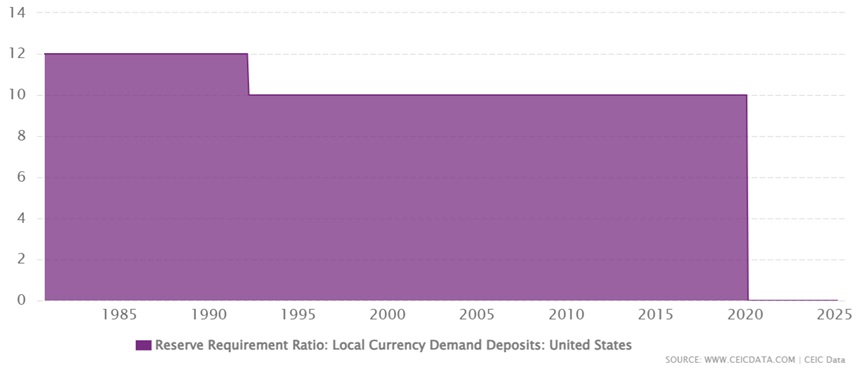
The Reserve Requirement was the LEAST used
tool of monetary policy within a Limited Reserves
framework.
The Federal Reserve changed the main reserve
requirement ratio (on net transaction accounts
above the low reserve tranche) only one time
between 1990 and 2008.
In April 1992, the Fed lowered the required reserve
ratio on net transaction accounts above the low
reserve tranche from 12% to 10%. See purple
graph below.
tool of monetary policy within a Limited Reserves
framework.
The Federal Reserve changed the main reserve
requirement ratio (on net transaction accounts
above the low reserve tranche) only one time
between 1990 and 2008.
In April 1992, the Fed lowered the required reserve
ratio on net transaction accounts above the low
reserve tranche from 12% to 10%. See purple
graph below.
A Limited Reserves framework was designed so
that banks held only what was needed to meet the
reserve requirement. If banks fell short on these
reserves, banks could borrow from other banks'
that had excess reserves to lend overnight.
Banks held very few excess reserves because it
was not profitable, as excess reserves earn no
interest on these reserves. Banks were
incentivized to lend out excess reserves to earn
interest, as holding onto them meant forgoing
potential loan profits.
that banks held only what was needed to meet the
reserve requirement. If banks fell short on these
reserves, banks could borrow from other banks'
that had excess reserves to lend overnight.
Banks held very few excess reserves because it
was not profitable, as excess reserves earn no
interest on these reserves. Banks were
incentivized to lend out excess reserves to earn
interest, as holding onto them meant forgoing
potential loan profits.
Required Reserves -- Banks were required to hold
a certain percentage of their reserves as required
reserves with the Federal Reserves or inside their
own vaults.
Notice on the FRED graph below how the RR did
not fluctuate all that much between $40 billion -
$47 billion.
a certain percentage of their reserves as required
reserves with the Federal Reserves or inside their
own vaults.
Notice on the FRED graph below how the RR did
not fluctuate all that much between $40 billion -
$47 billion.
Excess Reserves -- Excess reserves are each
bank's cash and deposits held above the minimum
amount required by the central bank.
Notice on the FRED graph below how the ER did
not fluctuate all that much in millions of dollars.
bank's cash and deposits held above the minimum
amount required by the central bank.
Notice on the FRED graph below how the ER did
not fluctuate all that much in millions of dollars.
| Reserve Requirement (Least Used Tool) |
| Open Market Operations (Most Used Tool) |
Open market operations was the most used tool of monetary policy in the limited reserves framework because the Federal Reserve used them
daily to fine-tune the federal funds rate. The Fed would buy and sell government securities to increase or decrease the supply of bank reserves,
influencing the interest rate at which banks lend reserves to each other.
Within a Limited Reserves Framework, the Federal Reserve Bank of New York's Open Market Trading Desk (known as the NY Desk) was in frequent
contact with the other 12 Reserve Bank presidents. Regular contact was essential for policy implementation, as the New York Desk managed open
market operations and worked closely with regional presidents who gathered information from their districts
daily to fine-tune the federal funds rate. The Fed would buy and sell government securities to increase or decrease the supply of bank reserves,
influencing the interest rate at which banks lend reserves to each other.
Within a Limited Reserves Framework, the Federal Reserve Bank of New York's Open Market Trading Desk (known as the NY Desk) was in frequent
contact with the other 12 Reserve Bank presidents. Regular contact was essential for policy implementation, as the New York Desk managed open
market operations and worked closely with regional presidents who gathered information from their districts
| Discount Rate (Boundary Rate) transitions to the Primary Credit Rate (Ceiling Rate) |
The Discount Rate traditionally acted as a boundary rate for the Federal Funds Target Rate (FFR).
The Federal Reserve shifted from the Discount Rate (DR) to the Primary Credit Rate (PCR) in 2003 to reduce the "stigma" associated with borrowing
from the discount window. This involved replacing the old, administratively burdensome Discount Rate (DR) with a new, simplified one, the Primary
Credit Rate (PCR), where the PCR was set above the Federal Funds Target Rate (FFR) would be charged to generally sound banks, making the
discount window more accessible without the perceived negative implications of borrowing from the Fed at the Discount Rate, which was heavily
scrutinized and "frowned upon" by the Federal Reserve.
The Federal Reserve shifted from the Discount Rate (DR) to the Primary Credit Rate (PCR) in 2003 to reduce the "stigma" associated with borrowing
from the discount window. This involved replacing the old, administratively burdensome Discount Rate (DR) with a new, simplified one, the Primary
Credit Rate (PCR), where the PCR was set above the Federal Funds Target Rate (FFR) would be charged to generally sound banks, making the
discount window more accessible without the perceived negative implications of borrowing from the Fed at the Discount Rate, which was heavily
scrutinized and "frowned upon" by the Federal Reserve.
| "Emerging economy central banks maintain reserve requirements to ensure financial stability, manage liquidity, and anchor monetary policy in volatile markets. These reserves act as a crucial buffer against capital outflows, support the local currency, meet international obligations, and manage excessive risk-taking by banks, often serving as a necessary tool in less developed financial systems." Google ASK AI 4 |
Many EMERGING countries' central banks still use some variation(s) of the
Limited Reserves Framework. This is shown in the table below in a PDF listing the different
countries central banks' Required Reserves Ratio over time. NOTE: You can enlarge this
PDF document.
Most MAJOR central banks use an Ample Reserves Framework, according to the Federal
Reserve and other sources. This is due in part to large asset purchases by central banks to
stimulate the economy and support financial stability. You will learn more about Ample
Reserves in Week 14 lessons.
Limited Reserves Framework. This is shown in the table below in a PDF listing the different
countries central banks' Required Reserves Ratio over time. NOTE: You can enlarge this
PDF document.
Most MAJOR central banks use an Ample Reserves Framework, according to the Federal
Reserve and other sources. This is due in part to large asset purchases by central banks to
stimulate the economy and support financial stability. You will learn more about Ample
Reserves in Week 14 lessons.
| 1982 - 2008 |
The Federal Reserve is the lender of last resort through the
Federal Reserve of New York's Discount Window:
The Primary Credit Rate, formerly called the Discount Rate
until 2003, serves as the principal safety valve for ensuring
adequate liquidity in the banking system. It is available to
depository institutions that are in generally sound financial
condition, and there are no restrictions on the use of funds
borrowed under primary credit.
The term "Discount Rate" is no longer used in the Federal
Reserve's press release after its FOMC meetings. Instead,
"Primary Credit Rate" has taken its place.
Federal Reserve of New York's Discount Window:
The Primary Credit Rate, formerly called the Discount Rate
until 2003, serves as the principal safety valve for ensuring
adequate liquidity in the banking system. It is available to
depository institutions that are in generally sound financial
condition, and there are no restrictions on the use of funds
borrowed under primary credit.
The term "Discount Rate" is no longer used in the Federal
Reserve's press release after its FOMC meetings. Instead,
"Primary Credit Rate" has taken its place.
| The "Discount Rate" is DISCONTINUED and replaced by the "Primary Credit Rate" |
| 2003 (January) |
| Touch the colored lines on the graph to see when the Discount Rate term ended and the Primary Credit Rate term began. |
| 1982 - 2008 |
- - - - - - - - - - - - - - - - - - - - - - - - - - - - - - - - - - - - - - - - - - - -
| Three Activities (2003 - 2008) |
| Many Emerging Economies use Limited Reserves |